> For the complete documentation index, see [llms.txt](https://docs.talus.network/llms.txt). Markdown versions of documentation pages are available by appending `.md` to page URLs; this page is available as [Markdown](https://docs.talus.network/guides/sdk.md).
# Nexus SDK Integration
{% hint style="info" %}
**Audience:** Rust application developers and service operators who need direct access to Nexus objects, Sui RPC, typed events, or transaction builders.
**Goal:** Choose the direct SDK boundary, keep signing and custody server-side, and verify every read or transaction against authoritative Sui state.
{% endhint %}
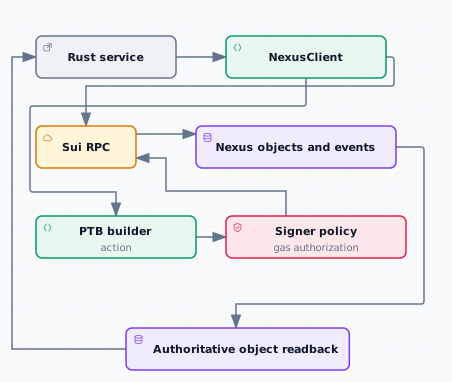
The Nexus SDK is a Rust client over Sui RPC and programmable transactions. It reads durable Nexus objects, decodes typed events, and composes action/PTB builders. Choose this topic when your service needs a signer, gas source, BCS/object reads, or direct transaction effects.
This architecture separates transient application state from durable on-chain state: the SDK can observe events for timely invalidation, but the post-transaction object read and effects are the correctness boundary. Keep private keys and gas outside browser code, and treat the deployment package graph, RuntimeAuthority, package era, and object references as operator-supplied inputs.
### Start here
| Need | Page |
| ---------------------------------------------------------------------------------------- | ------------------------------------------------------------------------------------------------------------- |
| Build a query-only server with typed reads, replayable events, and a narrow browser view | [Build a query monitor](/guides/sdk/build-a-query-monitor.md) |
| Construct a client with configured object bindings | [Client construction](/reference/sdk/client.md) and [Decoded SDK types](/reference/sdk/types.md) |
| Read typed Nexus objects | [Crawler reference](/reference/sdk/crawler.md) and [Decoded types](/reference/sdk/types.md) |
| Consume event pages with checkpoints, replay-gap recovery, and cancellation | [Event ingestion](/reference/sdk/events.md) |
| Compose direct writes and inspect effects | [Transactions](/reference/sdk/transactions.md) and [SDK integration reference](/reference/sdk/integration.md) |
#### Boundary and availability
The generated SDK reference describes the API used by this guide, while the authored integration page explains application responsibilities that generated signatures cannot establish. If the selected build or network does not match the documented Invocation and RuntimeAuthority surfaces, stop at query-only Task/Execution/payment evidence and correct the package or binding mismatch. A deployment URL or configured `NexusObjects` value is not inferred from this page.
Next: [Build a query monitor](/guides/sdk/build-a-query-monitor.md), or return to the [Guides overview](/guides/guides.md).
---
# Agent Instructions
This documentation is published with GitBook. GitBook is the documentation platform designed so that both humans and AI agents can read, navigate, and reason over technical content effectively. Learn more at gitbook.com.
## Querying This Documentation
If you need additional information that is not directly available in this page, you can query the documentation dynamically by asking a question.
Perform an HTTP GET request on the following URL with the `ask` and `goal` query parameters:
```
GET https://docs.talus.network/guides/sdk.md?ask=&goal=
```
`ask` is the immediate question: it should be specific, self-contained, and written in natural language.
`goal` is what the user is ultimately trying to achieve, the reason they need the answer. Sharing it helps GitBook give you a better, more relevant answer. A goal is most helpful when it describes the outcome the user wants rather than restating the question. For example, with `ask=how do I create an API token`, a goal like `build a script that syncs our docs to a CMS` lets GitBook tailor the answer to that use case.
The response will contain a direct answer to the question and relevant excerpts and sources from the documentation.
Use this mechanism when the answer is not explicitly present in the current page, you need clarification or additional context, or you want to retrieve related documentation sections.