> For the complete documentation index, see [llms.txt](https://docs.talus.network/llms.txt). Markdown versions of documentation pages are available by appending `.md` to page URLs; this page is available as [Markdown](https://docs.talus.network/talus-docs-v2.1.0/reference/reference.md).
# Nexus Reference
{% hint style="info" %}
**Audience:** Developers and integrators who need exact Nexus surface descriptions.
**Goal:** Choose the canonical generated family for Move, SDK, CLI, Toolkit, or hosted Nexus API endpoints after learning the Concepts and Guides.
{% endhint %}
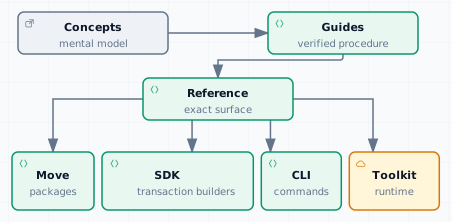
Reference pages answer “what exact surface or field does this contract expose?” Concepts establish the model first; Guides show a safe procedure; Reference records the public endpoint, type, command, signature, or receipt vocabulary.
> **Before executing a reference example:** Verify that the installed binary and bindings, configured package IDs and network objects, and transaction effects agree with the selected network. Hosted projections remain provider-owned views.
Each generated page records its exact source revision. Follow [Pinned source installation](/talus-docs-v2.1.0/guides/getting-started/setup.md#pinned-checkout-and-install) for the long term supported `v2.1.0`; Nexus mutations also require matching authenticated Nexus object bindings.
### Surface families
| Need | Canonical family |
| ----------------------------------------------------------------------------------------------------------------- | ------------------------------------------------------------ |
| Public Move types, functions, events, errors, and package modules | [Move reference](/talus-docs-v2.1.0/reference/move.md) |
| Rust client construction, crawler reads, workflow/scheduler/tool actions, transactions, decoded types, and errors | [SDK reference](/talus-docs-v2.1.0/reference/sdk.md) |
| Terminal command trees and flags | [CLI reference](/talus-docs-v2.1.0/reference/cli.md) |
| Toolkit traits, signed request context, and runtime integration | [Toolkit reference](/talus-docs-v2.1.0/reference/toolkit.md) |
Reference pages describe exact signatures and fields, not whether a particular network, hosted service, or installed binary exposes them. Use the owning Concept or Guide for the behavioral invariant and verify the deployment tuple before execution.
---
# Agent Instructions
This documentation is published with GitBook. GitBook is the documentation platform designed so that both humans and AI agents can read, navigate, and reason over technical content effectively. Learn more at gitbook.com.
## Querying This Documentation
If you need additional information that is not directly available in this page, you can query the documentation dynamically by asking a question.
Perform an HTTP GET request on the following URL with the `ask` and `goal` query parameters:
```
GET https://docs.talus.network/talus-docs-v2.1.0/reference/reference.md?ask=&goal=
```
`ask` is the immediate question: it should be specific, self-contained, and written in natural language.
`goal` is what the user is ultimately trying to achieve, the reason they need the answer. Sharing it helps GitBook give you a better, more relevant answer. A goal is most helpful when it describes the outcome the user wants rather than restating the question. For example, with `ask=how do I create an API token`, a goal like `build a script that syncs our docs to a CMS` lets GitBook tailor the answer to that use case.
The response will contain a direct answer to the question and relevant excerpts and sources from the documentation.
Use this mechanism when the answer is not explicitly present in the current page, you need clarification or additional context, or you want to retrieve related documentation sections.